The US-Mexico-Canada Agreement (USMCA, or CUSMA in Canada) is a comprehensive free trade and investment agreement between Canada, Mexico and the USA. It came into force on 1 July 2020. It replaced the then groundbreaking North American Free Trade Agreement (NAFTA) which took effect on 1 January 1994.
NAFTA was an expansion of the 1989 Canada-US Trade Agreement (CUSTA) and was seen as a landmark in setting higher standards in a range of areas, including agriculture, investment, intellectual property, and services.
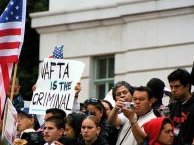
Dubbed a “death sentence” for Mexico’s campesinos and Indigenous Peoples, NAFTA sparked strong and sustained people’s resistance in Mexico, including the Zapatista uprising. Since taking effect, cheap, subsidized US corn has flooded the market, priced below the cost of production, with which campesinos cannot compete.
Almost two million jobs were lost in Mexico’s agriculture sector in NAFTA’s first ten years. This has led to massive displacement, poverty, and hunger.
NAFTA’s Investor-State Dispute Settlement (ISDS) mechanism - in which an investor from one signatory country can sue the government of another signatory country for actions or omissions which it claims to interfere with its right to make a profit - raised concerns about the way in which the agreement furthered the interests of transnational corporations, and limited the capacity of governments to regulate the economy for social, environmental or other reasons.
The ISDS mechanism has taken a toll on Mexico and Canada, which have been sued respectively 20 times and 27 times, mostly by US investors.
NAFTA was also criticized for boosting low wage and working conditions jobs, especially along the US-Mexico border, where over 3,000 maquiladoras employ over a million Mexicans, mostly women who earn about US$5 a day.
On 1 January 2008, the last agricultural tariffs were eliminated under NAFTA and small farm organizations in Mexico declared “all-out war” on the trade agreement, arguing that the country’s food sovereignty and security are in peril. Massive peasant demonstrations against NAFTA were held throughout Mexico in early 2008.
The 2016 Trump presidential campaign called for NAFTA’s termination. But instead, the new US administration decided to tweak the deal and started the renegotiation process in May 2017.
The USMCA was signed on 30 November 2018, after the US clinched separate deals with Canada and Mexico. Mexico ratified the agreement in June 2019. Ratification is pending in Canada, but stalled in the US, due to concerns of the Democrat-controlled House of Representatives over workers rights, the environment and issues related to pharmaceuticals.
The USMCA has been criticized for going even further towards trade liberalization than NAFTA. Small farmers’ organizations say that it will privilege large agribusiness corporations over family farmers and the environment (including climate change). Public information about chemicals used in agriculture and food labeling will also be limited. In May 2017, many groups met in Mexico City and called for a new model of integration, cooperation and exchange among nations that respects human, political, economic, social, cultural and environmental rights.
The new NAFTA follows the US-proposed language on intellectual property and e-commerce in the Trans-Pacific Partnership (TPP) – now Comprehensive and Progressive TPP without the US. It will force Mexico to join the UPOV91 Convention - plant variety protection patent-like rules which prevent farmers from saving and exchanging seeds. It also restricts data localization policies and bans restrictions on data transfers across borders, procedures that can be used to keep sensitive personal information, such as health data, within local jurisdictions. The deal originally provided a minimum of 10 years of marketing exclusivity for cutting-edge biologic medicines, which include many new cancer treatments and even vaccines, beyond the 20 years of patent protection stated in TRIPs (Trade-Related aspects of Intellectual Property rights) standards but the provision was removed eventually.
Negotiators claim to have secured sweeping progress on labour protection However, no clear enforcement mechanism is set down so these are little more than voluntary guidelines.
The ISDS mechanism between the US and Canada, and between Mexico and Canada has been removed – even though it is included in the TPP, to which both countries belong. New procedures replace the ISDS between the US and Mexico. Expansive rights for investors are mostly terminated. Only limited claims are allowed after exhaustion of local remedies. But the ISDS mechanism has been maintained between the two countries for claims pertaining to Mexico’s oil and gas sector.
The text of the agreement: https://www.bilaterals.org/?united-states-mexico-canada
last update: August 2021
Photo: Jim Winstead/CC BY 2.0
 :
: